Types of eclipses in India…

Bangalore Eclipse: The obscuration of the light of the sun by the intervention of clouds between the sun and Bangalore city. Happens for more than half of the days of the year. Sometimes overpowers solar eclipses too. More severe in Cherrapunji and Mawsynram.

Delhi Eclipse: The obscuration of the light of the sun by the intervention of pollutants between the sun and Delhi city. More in some areas and also depends on state policies like CNG regulation and crackdown of industrial areas. Present to some extent in other Indian cities too.

Mumbai Eclipse: The obscuration of the light of the sun by the intervention of skyscrapers between the sun and certain vertically challenged buildings in the city. Certain sections of certain buildings haven’t seen the sun for decades. Also called permanent partial eclipse. Also present in certain parts of East Delhi.

Ahmedabad Eclipse: The obscuration of the light of the sun by the intervention of kites between the sun and Ahmedabad city. For this reason, Ahmedabad celebrated eclipse on January 14 instead of 15. Catching on in other Indian cities too.

This Version By Sunil Rajguru

The All is Well Book Series…

All is Well: An Optimist’s Take on Life

All is Not Well: The Pessimist’s Counter to The Optimist’s Take

Is All Really Well? A Collection of Conspiracy Theories

How All Can Be Well: A Doctor’s Guide to Everlasting Health

To Be Well or Not To Be Well, That Is The Question: Existential Thoughts

All is Sales: How Controversies Are Actually Good for Business

All is Male: A Feminist’s Guide to India

All is Veil: The Real Story of Women in Afghanistan

All Izz Not Really Well: All About Bollywood Screenplays

All is Jail and Bail: How Convicts Always Escape in India

All is Pale: The Fair & Lovely Story

All is Not Rail: How Laloo Got Out of His Post-Ministerial Depression

All is Derail: The Mamata Story

Gone is Retail: The Slowdown of 2009

The Tail is Frail: Getting Bowlers to Bat For Long

All Is Not Email: How The Indian Post Re-Invented Itself

This Version By Sunil Rajguru

Get a (night) life!

mumbai-390486_1280It was another get-together dinner (“night party” as the kids fondly call it) with our neighbours. To end a perfect evening, everyone demanded a round of paan. The three of us headed straight for our favourite paanwallah. The guy took our order and then surprisingly requested us to park the car a few dozen feet away, as the police was on patrol. It was an unearthly 10.55 pm and he had to shut shop at sharp 11.

Strange, we thought, but followed his instructions all the same. While we were waiting, there was a suddenly a flurry of activity. All the crates and stuff were pulled in and the shutters slammed down. It was as if some attack had just begun somewhere. We waited and waited and waited.

Meanwhile a police patrol van came and stared at us as if we were all known rowdies. The paanwallah got a few glares too. He came running towards us and requested us to take a round and come in five minutes. We all stared at each other and shrugged our shoulders. I generally wondered in silence why nightlife in Bangalore sucked.

When we came back, just avoiding the patrol van, the paanwallah signaled us to be on the other side of the road at a distance. The shutters surreptitiously came up and a hand gave a plastic packet. The paanwallah came running across the road, turned his back to us looking left and right and handed the packet. We tendered exact change and he ran off without even looking at it. Anyone watching at a distance would have been sure that the packet had drugs or atleast illicit liquor. But we were just having paan, for crying out loud!

The same old story…

Reminded me of the time when, as students, we reached the liquor shop in Viveknagar in Bangalore at exactly 10 pm to find the shop closing. My friend dived and we saw his shoe soles disappearing just as the shutters came down. That was a very dangerous thing to do. A fraction of a second late or a fraction of a centimeter wide and he might have had a few broken bones. (Later, however, we always remembered it as a glorious Mission Impossible type moment.) Minutes later, my friend triumphantly emerged from another door with a bottle. It was as if he had broken some great odds and was really proud of it.

Reminded me of the time when, in Noida with the very same friend, we decided to go and search for dinner at the “unearthly” hour of 10pm. Suddenly in pitch darkness we heard shrill whistling and before we knew it cops surrounded us. “Who are you?” “What are you doing?” “Are you new to this area?” It was a scene straight out of a Bollywood movie where the cops were on the verge of catching some known gangsters.

When we stated our intent, a cop laughed and told us to go home and sleep. There was a daily curfew. Nothing stayed open beyond 930-10pm for safety reasons. Not even dinner. Then I think he relaxed his hand on what looked like a gun. It was difficult to tell as they were wearing shawls to escape the Delhi winters. I guess it was truly a crime for a bachelor to be hungry beyond 10 in this zone. We were too stunned to even play our Hindustan Times press cards, which works so well in the NCR region. The absurdity of it all!

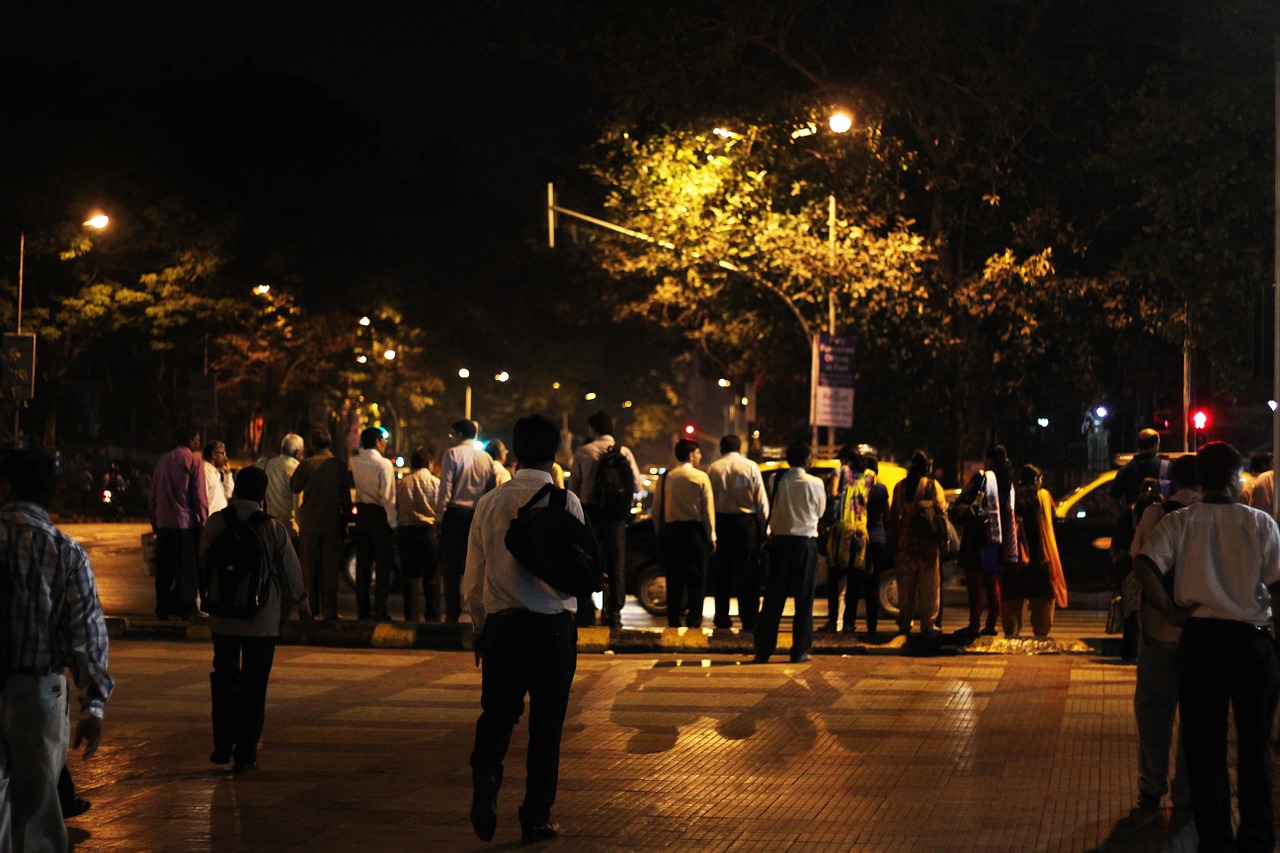
Reminded me of my night shifts at the Hindustan Times in Connaught Place, the heart of Delhi. Bustling with shops and people from all over throughout a day, after 7pm they all started closing one by one. Beyond 8, the centre used to be a circle of darkness and a haven for criminals. When I used to walk from the bus stop to the office, I used to wonder whether this blackness was actually the capital of modern India. At this time, most world cities would just start waking up with their nightlives.

While some cities do have it, why does nightlife in India generally have to be so non-existent?

Once upon a time…

…in socialist India, there were few cars and scooters, few nightclubs and few ways for one to get around even after 9 in the night. No matter how badly he wanted it, the common man couldn’t get a nightlife. Authorities, probably in order to avoid complications and crime, clamped down and enforced all sorts of curfews. It may have made sense at that time. Going by Bollywood movies, everything that operated late was associated with either smuggling or gambling or with criminals or seedy red-light areas. But that era seems more than a lifetime away, even for me who grew up in it.

Today…

…people work late, do night shifts, catch flights at odd hours and have enough means of transportation for the night. Satellite TV and the Internet both have given rise to a 24-hour lifestyle. There’s no point in restricting this outside the home. A lot of Indian conservatives still frown upon the “nightlife” concept of discos, pubs, nightclubs, bars and the like. But what logic is there in not allowing shops, restaurants, coffee shops and thelas for 24 hours? Why can’t all multiplexes and movie halls screen movies from midnight to early morning? In the cities, there will always be takers for it.

If anything, it might also prevent crime thanks to the presence of late night crowds. In our country, everything has moved forward except the governments and their sets of archaic rules. This is such an elementary thing and doesn’t even require legislation. Cities can start easing things on their own. But the authorities are still quite comfortable imposing curfews for 7pm, 9pm, 10pm… depending on which area you are in. For what joy? Do they all go home and sleep early?

We have such hectic lifestyles and want to do so much in the day. By imposing deadlines on the things we can do outside at night and hence squeezing the already limited amount of time… just doesn’t make sense.

I wish the authorities got a life and gave us one too.

© Sunil Rajguru
Contemporary Tongue Twisters

The fixth fick fheik’f fixth fheep’f fick.

Seeing Sharm el-Sheikh’s sellout saga seriously shell-shocked some short-sighted security experts.

A crabby drab barb on Pranab’s garb grabbed crabby scrappy Pranav.

WADA Drama WADA Drama WADA Drama WADA Drama…

Asking Aussie’s Ashes Assurance.

Risking Delhi airport’s six fixed mist lists.

Six sick swine sickened six slick shaking skaters.

A swiss swine swayed on a wine glass with a swine sign as a far-flung fluttering flu-hit fowl flew fleetingly.

How much paisa would a politican pilfer, if a politican could pilfer paisa? A politician would pilfer as much paisa as a politician could pilfer, if a politician could pilfer paisa.

Rocking Rakhi’s Swayamwar swayed several severe swearing sweltering seriously shocked viewers.

This version by Sunil Rajguru

Trying to be a bad writer and failing at that too…

Every year the Bulwer-Lytton Fiction Contest invites writers “to compose the opening sentence to the worst of all possible novels”. This year I decided to give it a shot. How bad could writing bad writing be after all? The intro to the “worst” novel has to be a sentence between 50-60 words in it. I was taught in my journalism college that the perfect newspaper sentence was between 14 and 18 words. So clearly my education wasn’t enough to cope with such a task.

I would have to invoke the spirit of Charles Dickens, that master of the long sentences. But his sentences were beautiful and something clearly from the mind of a genius. Mine would have to be ugly. I also remember one sentence in A Hundred Years of Solitude that lasted a few pages! But even that was more of a literary roller coaster pleasure ride.

Finally, in my own moment of inspiration, I wrote four really bad intros at one sitting. I emailed them and waited for the results. I didn’t win anything, not even a special mention. In the end, I guess they were simply not bad enough. Guess I’ll have to simply try again next year and see if I can sing Michael Jackson’s “I’m bad, I’m bad…” with some sort of conviction.

I am reproducing below my Not-so-prize-Winning Entries:

1.
He was born in Hiroshoma, only to die during the N-blast, re-incarnated as a cockroach to be crushed, reincarnated again as a car which crashed in the test drive, in the end it would destroy itself the moment it was created, releasing energy which was measured by scientists in the long run to measure impending doom.

2.
When he visited Obama he found it ironic as he observed the great man’s black shadow fall on a white napkin, which happened to be on a black tablecloth on a white floor in a black room (as the electricity just failed) in the White House in a grim black world, with white sunshine.

3.
The quark flew out of the proton, destroying the atom, unsettling the molecule, upsetting the chemical structure of the cell of the bacteria nested in his stomach lining and he burped loudly even though his stomach was dry and empty and an unheard of scientific phenomena just passed by, like a million others.

4.
She heard the song Mamma Mia and so watched the movie and thought of her Mamma who she visited and who just died a second before she arrived wishing she had picked up the ABBA cassette a little earlier so she could have got a last glimpse of her alive Mamma.

(For more information about the contest, check the Wikipedia Entry)

© Sunil Rajguru

God Bless Them…

Once I was reading an article in a magazine which had a round up of the year’s major events. There was a collage of achievers. Out of all the varied images, the face of a famous beauty queen was blocked by the magazine’s logo. “Look what they’ve done to her face,” I said to my flat-mate. He looked at the mutilated figure wearily and exclaimed, “God bless them! I’m sick and tired of that face.”

I stopped and thought for a moment. I found that I agreed with him. Though this face was beautiful and gorgeous (declared the most symmetric face in the world by one magazine) even I was weary of it. I guess a lot of other people felt that way too. And to think I was so ecstatic when she won an international beauty pageant. Go India go! So I guess today a celebrity, or a hero or an idol is like a tube of toothpaste. You have to keep changing it every now and then.

I wonder. Did the same thing happen thousands of years ago? Were men who won the ancient Olympics treated like stale cakes a few years after they won their laurel wreaths? Did the Romans get tired of talking about the greatness of Caesar? When Shakespeare was mentioned in the 17th century England, did someone say, “Oh, no! Not him again!” Probably not!

Historians may disagree. But considering the conditions, population and developments of the present century, the achievements of many current greats rank next to, if not greater than, those in the past. Both shared the same strengths and weaknesses. Both fought against the same type of odds. Both changed lives. Yet our present day heroes fall from grace much too easily. In contrast their counterparts in the ancient world carried an aura of invincibility right up to (and much after) their deaths.

Things have been changing for centuries, but perhaps the advent of the daily newspaper drastically altered equations. The media plays the biggest role in snatching away a person’s aura. A man and his achievements are two separate things. In the good old days, the public saw only the cloak of achievements and the actual man, who might be very weak in his personal life.

In contrast, today the media puts a person’s cloak of achievement in front of the public giving a massive overdose, which leads to the overkill. Then paradoxically at the same time it slowly pulls down the cloak showing the world what an ordinary mortal he actually is. This “double action” seems to be a great favourite of the media.

Imagine Emperor Ashok being scrutinized by the world’s press thousands of years ago. He might have read headlines like, Ashok massacres the Kalingans, Thousands killed in Kalinga conflict, Why did Ashok commit Genocide?… Then there would have been the hounding of the reporters, the analyses, investigative reports… I can’t even imagine what our 24-hour news channels would make out of events like that. The pressure would have been far too much for Ashok and he would have renounced warfare (earlier than he did in real life) Now that would have been viewed as the victory of the free press and not his greatness. Such a scenario would have unfolded with every great event and every great person. Think over it. There would be a hundredfold history books and most of them would not have been in favourable light about our greats. You wouldn’t view history the same. In fact you would be viewing history with the same glasses that the media puts in front of your eyes today.

This is the essential difference. While ancients looked at their greats from afar, we look at ours from too close a distance. While Old Greats are read only in academic history books (which are treated with great respect), New Greats are seen in cheap newspapers and even cheaper news channels, which put everything in the light of the mundane.

The further in the past you look, the greater the men appear. But that may not hold true in the future with the way things are going.

© Sunil Rajguru