Bollywood formulae…

Akshay Kumar + Vulgar Script + Over the Top Comedy + Katrina Kaif = 1 Superhit

Akshay Kumar + Vulgar Script + Over the Top Comedy – Katrina Kaif = 1 Superflop

Hero = Producer = Director = Creative Head = The Future of All Aamir Khan Movies

1 Father + 1 Son + The Letter K + Any Script/Story = A Hrithik Roshan Superhit

Film star + IPL Team = No Hope of Lifting the IPL Trophy

1 Yesteryears Actor + 1 Yesteryears Actress + 1 Item Girl + 1 Bollywood Side Star = Bigg Boss House

1 Profession + 1 Strong Heroine + Loads of Realism = A Madhur Bhandarkar film

Any Hero + Any Heroine + Any Comedy Movie + Ritesh Deshmukh = A Commission Earner

Akshay Kumar + Sunil Shetty + Paresh Rawal + Priyadarshan = Hera Pheri 1,2,3,4,5…

1 Quickly Made Film + 1 New Heroine + 1 New Director + 1 Don/Ghost = Has to be RGV

Rani Mukherji + Rumours of Marriage with Aditya Chopra = Career Gone Bust

Some pretty old ones…

A Bhatt Film + 1 New Heroine + Multiple Kisses + Great Music = An Emraan Hashmi Hit

Love Story + Designer Clothes + Chiffon Sarees + Switzerland Song Sequence + Lata Theme Song = A Yash Raj Film

Many Designer Sets + 1 SRK + Loads of Melodrama + Rani/Kajol Starring/Guests = A Karan Johar film

This Version By Sunil Rajguru

Slamdog Everywhere

So Slumdog Millionaire finally won 8 Oscars. It’s funny how it’s so panned inside India and so critically acclaimed outside it (100 plus international awards in 4 months). While it’s OK to criticize a movie if you don’t like it, I’m really surprised at the kind of slamming that Slumdog is getting.

First things first. Is there any rule on where a film story can be based? I guess not. Your film can have a setting in India, America, Antarctica, the moon, a galaxy that doesn’t exist, a few thousand years in the past, a few hundred years into the future and even an alleged parallel dimension. That’s what cinema is all about and variety keeps the box office ticking.

So why can’t a foreign director base a film in the slums of Mumbai? Fair enough? Secondly, what will any director try to do when making a film? He’ll try to make it as realistic as possible. Whether it’s Stanley Kubrick’s Space Odyssey: 2001 or Troy or City of God or our very own Lagaan, directors try to make their movies as believable as they can. If you’ve seen the movie, please tell me what part is false or incorrect. Events like the ones depicted have taken place and continue to do so. Nothing wrong with that too.

Then they say that this is exploitation of slums and poverty is being exported. But if you’ve seen the film then you’ll also agree that more than the depiction of the slums, it is a celebration of life itself. The two brothers are shown playing cricket, enjoying being chased by the police and generally having a good time.

Spoiler follows…

It’s a movie about the triumph of human spirit. While our protagonists keep getting into scrapes, they keep getting out of them. Despite the loss of their mother, they move on. Despite being captured by a gang who wants to make one of them blind, they escape. Despite being absolute newcomers in Agra, they manage to make a living there. Despite carving out a cushy life in a new city, they come back to rescue the girl in Mumbai. Our hero gets third degree all night in a police cell and yet sits it his chair and stares angrily at the sub-inspector with his pride intact. In the end he becomes a millionaire, gets the girl and gets rid of the bad boys. That’s a feel-good film with a happy ending. Not an “arty” film which exports India’s poverty.

Spoiler ends…

“Triumph of the Underdog” and “Destiny”

One reason why Hollywood has loved the movie so much is because it shows the triumph of the underdog. (Slumdog = Slum + Underdog) I had read an article many years back on the American film industry which claimed that when the Jews took over Hollywood, they transferred their “outsider” status into the movie stories. Their heroes were rarely part of the mainstream society. The trend continues till this day. Look at some of the top grossers of all time.

What chance does Frodo Baggins have in a world full of powerful sorcerers? What chance does an ogre called Shrek have of winning the princess’ heart? What chance does computer programmer Thomas A. Anderson have of becoming Neo and saving the world? What chance does a Mumbai slum kid have of becoming a millionaire?

More than slums, it is the very Indian concept of karma that is sold to western audiences. Destiny. It is written. It is only by luck by chance that Jamal wins. While the first half is a grim reality, the second half is the great escape. My guess is that most Indians stopped watching after the interval and that is exactly the image of Slumdog they have in their minds.

Summing up, I’d say the reason why Slumdog won big time is:

1.    It’s a perfect fusion of “arty” slums and Bollywood escapism along with British and Indian talent. Fresh for the West.
2.    It’s actually a Hollywood film masquerading as a Bollywood one.
3.    Since there were no nominations for best acting, it wasn’t in direct competition with Brad Pitt, Sean Penn, Kate Winslet etc.

Rahman Bashing

Another criticism is AR Rahman’s music. Most people (me included) agree that this is not his best piece of work. And yet he has got an Oscar, Golden Globe and BAFTA. That’s a big irritant for distracters. To answer that question, the way we regard music in films and the West does is totally different.

In Bollywood, they make good songs with good music and good lyrics. The idea is that the album should sell as a standalone product. That is more important than blending with the movie. That is why most of Bollywood albums can be enjoyed without knowing anything about the film whatsoever.

In the West they do it a little differently. The music has to be part of the plot and in the very fabric of the movie. That is why sometimes you may not enjoy the music album that much if you don’t see the movie. If you buy the music of Slumdog, you may or may not enjoy it. That’s irrelevant. What is relevant is how much you enjoy the music when you actually watch the movie. Does it blend with the movie? I think it does. Secondly, remember, Rahman was composing for an international audience and not a national one.

This is the best East-West fusion I’ve seen in a long time. Let’s hope this is the beginning of a new trend.

Quick Facts
1. The very first winner of UK’s Who wants to be a Millionaire was arrested on charges of cheating and later convicted.
2. A contestant of the Australian version of the game was also arrested but later cleared of wrongdoing.
3. The first winner of Kaun Banega Crorepati, Harshvardhan Navathe, was from Mumbai.
4. Vikas Swarup’s Q&A, on which the movie is based, does not focus on any particular game show in particular.

Post Script
Aren’t we all hypocrites to some extent? We don’t go near slums and we don’t talk to people from slums. And yet when a Britisher makes a film on slums, we all cry foul.

© Sunil Rajguru
Your songs put me off

My friend Prakash asked me the following question, “Which film is better? Taare Zameen Par or Slumdog Millionaire?”

My answer was the same as his: Taare Zameen Par.

To that I got the retort, “Then what kind of hypocrisy is this? Slumdog gets an Oscar and TZP doesn’t even get a nomination!”

Well, I can answer that question in one word.

Songs.

As long as Bollywood movies fit in half-a-dozen to a dozen inane songs, the majority of the West will not watch them. For us songs are a part and parcel of a movie. For the Westerner they aren’t. For a newcomer watching a good Bollywood movie, the moment a song comes, the flow is broken and he’ll walk out. (I used to do the same, much to the consternation of my wife) Even if he manages to sit through the first, he’ll walk out at the very next song. So how do you get the non-NRI audiences to even watch your films?

In the West, they make romances, musicals, thrillers, fantasies, comedies science fiction, horror, action, crime movies…

In India, we make musical romances, musical thrillers, musical fantasies, musical comedies, musical science fiction, musical horror, musical action, musical crime movies…

You can still argue that both Slumdog and TZP have songs. But Slumdog cleverly begins with one and ends with one, while the others play in the background subtly. In TZP , like every other Bollywood movie, things just seem to stop for the songs. If the movie is a musical in the first place, it’s fine, but if you try to pass off every movie as a musical with songs just for the heck of it, that doesn’t make sense.

Slumdog kept songs at the periphery and got Oscars for Best Original Score and Best Song. That’s the secret. Don’t stop the flow of the movie just for songs.

When Lagaan was nominated, a foreign critic said something to the effect of:  My personal favorite is Lagaan, but it has no chance of winning. An American jury will simply not sit through such a long movie with all its songs.

A possible solution

A few decades back the production standards of Bollywood movies weren’t that great and they relied on a lot of plagiarized plots. However off late a lot of slick movies have come out with slick plots. They could win international awards. What’s wrong with that?

So how do they go about doing it? One solution could be to release another version of the movie without songs for the international audience. If the songs took the movie forward, then it could be replaced by a voiceover, a montage of scenes or something like that. That’s the only way Bollywood can increase it’s audience and international awards kitty.

For years I’ve been told that Bollywood is unique with all its song and dance numbers. I for one think that’s absolute rubbish. Many a times songs spoil a perfectly good movie. The time has come for most of our film makers to do away with songs. Or in this era of choice, give a film to us in two flavours: With and without songs.

Quick Facts
Three Indians (AR Rahman, Resul Pookutty and Gulzar) won with Slumdog in a single night. Here’s India’s count before that:
Bhanu Uthaiya: Best Costume Design, Gandhi, 1982.
Satyajit Ray: Honorary Oscar, 1992.
Indian films nominated in the Best Foreign Language Film category: Mother India (1958), Salaam Bombay (1989), Lagaan (2002)
Indian directors/producers who’s films have won Oscars: Ismail Merchant and Shekhar Kapoor.
Winners with an Indian connection: Ben Kingsley (PIO) and Ruth Praver Jhabwala (Lived in India, married to a Parsi)
Nominations all: Ravi Shankar for Best Music in Gandhi and Ashmin Kumar’s The Little Terrorist, for Best Documentary in 2004. Indian-American Manoj Night Shyamalan has also been nominated.

Post Script
Not many people realize that the Oscars are not for English movies alone. Any movie of any language released in Los Angeles is eligible. Examples of foreign movies with multiple nominations in the main categories are French films Cyrano de Bergerac and Amelie along with the Danish film Pelle the Conqueror. So if Amitabh gives a sterling performance or Mani Ratnam directs a stunner, why not release that movie in LA and try for the main categories?

It’s not that we should be crazy about Hollywood or Oscars, but it’s just an additional territory that India could get into

© Sunil Rajguru

Hollywood’s toys for boys

Movie stars have been using a variety of tech marvels in action-packed blockbusters. But how realistic are the weapons they use?

A reality check

Clone a phone
SIM copier
Bourne Supremacy
There’s a cool scene where Matt Damon knocks down a US agent and takes his mobile in a flash. He then puts the SIM card into a GSM plugin SIM Adapter which is connected to a chip drive. The SIM configuration is downloaded into Damon’s mobile and he starts receiving calls without the US agent knowing.
Reality Meter: 5/5
These devices are in India and they may not be as fast as Damon, but your mobile card can be cloned in minutes! That means someone else can make umpteen calls and you’ll still get billed for it.

Stop a car
ESD
2 Fast 2 Furious
What’s the best way to catch a car with a daredevil driver? No you don’t have to overtake him. Just fire the Electrical System Disabler (ESD) and short circuit the car. In 2F2F, cops fire a 3-legged device from a small cannon gun which gets lodged in the body of the car, bringing the voltage down to zero and thereby stopping the car.
Reality Meter: 3/5
An electrical system gives power to, among other things, the ignition system through the car’s wiring. So theoretically it is possible to have such a device.

The impossible weapon
Light Saber
Star Wars series
The light saber is the ultimate weapon. Not only for a Jedi, but it’s the coolest weapon around. It can slice men and robots into two. It can cut through secure doors. The very sight strikes fear in the hearts of all. And it can fit neatly into your pocket.
Reality Meter: 0/5
By today’s technology, such a device would be near-impossible to make. For one, it would be very difficult to contain the length of a laser and secondly, one laser beam won’t stop another laser as they show in the fights. At best you could make a plasma saber, but to contain it in a magnetic field, it would take tonnes of energy.

A virtual me
Hologram projector
Star Wars series
Which Star Wars fan can forget R2D2′s hologram of Princess Leia in the original trilogy? In the seventies it was cool that you could save a moving image of someone and transport it elsewhere. Since then the hologram has been used in many movies.
Reality Meter: 5/5
The Mirage 3D Hologram Maker can make a hologram right in your in your home. It costs £20, check it out at www.optigone.com. Then there’s tele-immersion or live teleconferencing in the form of a hologram.

No mouse, no keyboard
Holographic database
Minority Report
Imagine doing away with the key and mouse and computer screen and replacing it all with a virtual image! Anyone who’s seen the movie will remember Tom Cruise going through a virtual database with nothing but his hands.
Reality Meter: 1/5
While we are still a long way away from such a virtual screen, many computer makers are already working on such a concept.

You don’t remember this
Memory Eraser
Men in Black series
Will Smith and Tommy Lee Jones at the end of every alien encounter use a pen-sized gadget that erases the memory of those around. Wiping out memory and modifying it has also been the subject of other movies like Total Recall.
Reality Meter: 0/5
While just about anything is possible in the future, right now we are nowhere near wiping out anyone’s “temporary memory” with just a flash.

I can see your underwear
Blue X-Ray Glasses
The World Is Not Enough
So many movies in the past have fantasized about X-ray goggles that can look through clothes and even James Bond couldn’t resist the temptation in the nineties, when Pierce Brosnan uses them to check out the ladies in a casino.
Reality Meter: 3/5
While X-ray technology is getting more and more sophisticated and the latest ones can see outlines inside clothes, they are still nowhere as clear as reel-life would like us to believe. Though scientists are still trying and trying…

Infecting the aliens
Apple PowerBook
Independence Day
Jeff Goldblum used his laptop to infect the alien attack fleet with a virus thereby crippling it and saving Planet Earth. An Apple PowerBook? That’s all you need to ward of aliens with awesome firepower? Cool!
Reality Meter: Unknown
While the Apple PowerBook exists, nobody has seen an alien computer to say conclusively whether it is Mac-compatible or not.

Traffic jam in the sky
Flying cars
Back to the Future series
What’s the best way to avoid traffic jams on Earth? Go upwards! However this movie portrays traffic jams even in the sky, the car population is expected to rise that much! There are also flying cars in The Fifth Element, Judge Dredd, Minority Report etc.
Reality Meter: 2/5
The Moller M400 and SkyCar are two cars that can fly, though they look more like planes. The M200X looked more like a UFO. So the only thing left to work out for a flying car is the “form factor”.

(This article appeared in Living Digital magazine in October 2005)

In Hollywood, tech gets a Perfect Ten

Computer-generated special effects have set the Hollywood box office on fire. Nineteen of the top twenty grossers of all time are powered by software

If you looked at the Hollywood list of all time Top Ten grossers till say 1990, then you had comedies like Home Alone, romances like Pretty Woman and Westerns like Dances with Wolves. Sci-Fi gatecrashers were Star Wars and ET.

However the nineties came and changed the rules of the game. If you didn’t have special effects then you didn’t stand a chance at the box office. A look at the current Top 10 grossers and how they relied on 3D computer generated imagery (CGI).

1. Titanic (1997), $1.8 billion
Director James Cameron founded visual effects company Digital Domain, which powered the Titanic. While the actual sinking of the real-life Titanic was explained on the computer in the movie, even the reel-life Titanic was fully computer generated. The unit relied heavily on Linux (which since then has become the staple fare for Hollywood) and more than 500 high-powered CPUs with more than 5 terabytes of disk space.

2. The Lord of the Rings: The Return of the King (2003), $1.1 b
Weta Digital was involved in thousands of detailed shots that required years to complete. And it kept getting more and more intense with every film in the trilogy. For example while LOTR 2 used more than 750 shots, the number crossed 1500 in LOTR 3. While Middle Earth was computer generated, so were many other characters like Gollum and even the Eye of Sauron. Other scenes were taken from real video shoots which then went through a lot of post-production compositing.

3. Harry Potter and the Sorcerer’s Stone (2001), $976 million
Flying brooms. Magical ceilings. Wizard’s chess. Wands and magic. Let’s face it; Harry Potter could never have been pulled off without heavy help from compositing software. The exciting game of Quidditch was mainly played in front of a blue screen and even the sound effects were computer generated. This was most difficult as such a game doesn’t exist and it had to be imagined entirely. The film also featured fabulous creatures like the giant three-headed dog Fluffy, a mountain troll, centaurs and unicorns. For the sorting hat both computer animation and a hat puppet were used.

4. Star Wars: Episode I-The Phantom Menace (1999), $926 m
George Lucas once said that he waited till technology became sufficiently advanced to make the prequels. Well the nineties provided him with the perfect platform and he made Episode 1, which is still the biggest Star Wars grosser of all time. In this movie, actors and acting took a backseat as it was all about Darth Maul with his two light sabers, the computer generated Jar Jar Binks (who proved to be a major irritant for fans), an underwater world and an epic war on Naboo which featured thousands of androids.

5. The Lord of the Rings: The Two Towers (2002), $925 m
In LOTR 2, computer generated Gollum came into his own and there were great Middle Earth battle scenes. The production department had to double their compositing unit team. In some of the battle scenes only the main characters were shot while the entire scenes with all their elements were created on the computer.

6. Jurassic Park (1993), $920 m
This was the first special effects movie that almost touched the $1 billion mark. It was made by none other than Steven Spielberg, who had already come out with Inner Space and ET. Till now CGI was used sparingly in certain movies. In this one, it was used throughout. Industrial Light and Magic succeeded in creating realistic fearsome large moving dinosaurs which got better and meaner in the Lost World and Jurassic Park 3.

7. Shrek 2 (2004), $881 m
DreamWorks SKG’s Shrek was probably the first movie fully made on Linux. That HP chose to use this movie in one of its ads shows you how much IT and Hollywood have become integrated. And the team is getting into higher and higher resolution models. From 2D models with the pencil, animators have firmly switched to 3D models with the mouse. Shrek 2 has a scene which features 6000 citizens and the crowd is pretty dynamic. Light and shade have also been presented realistically.

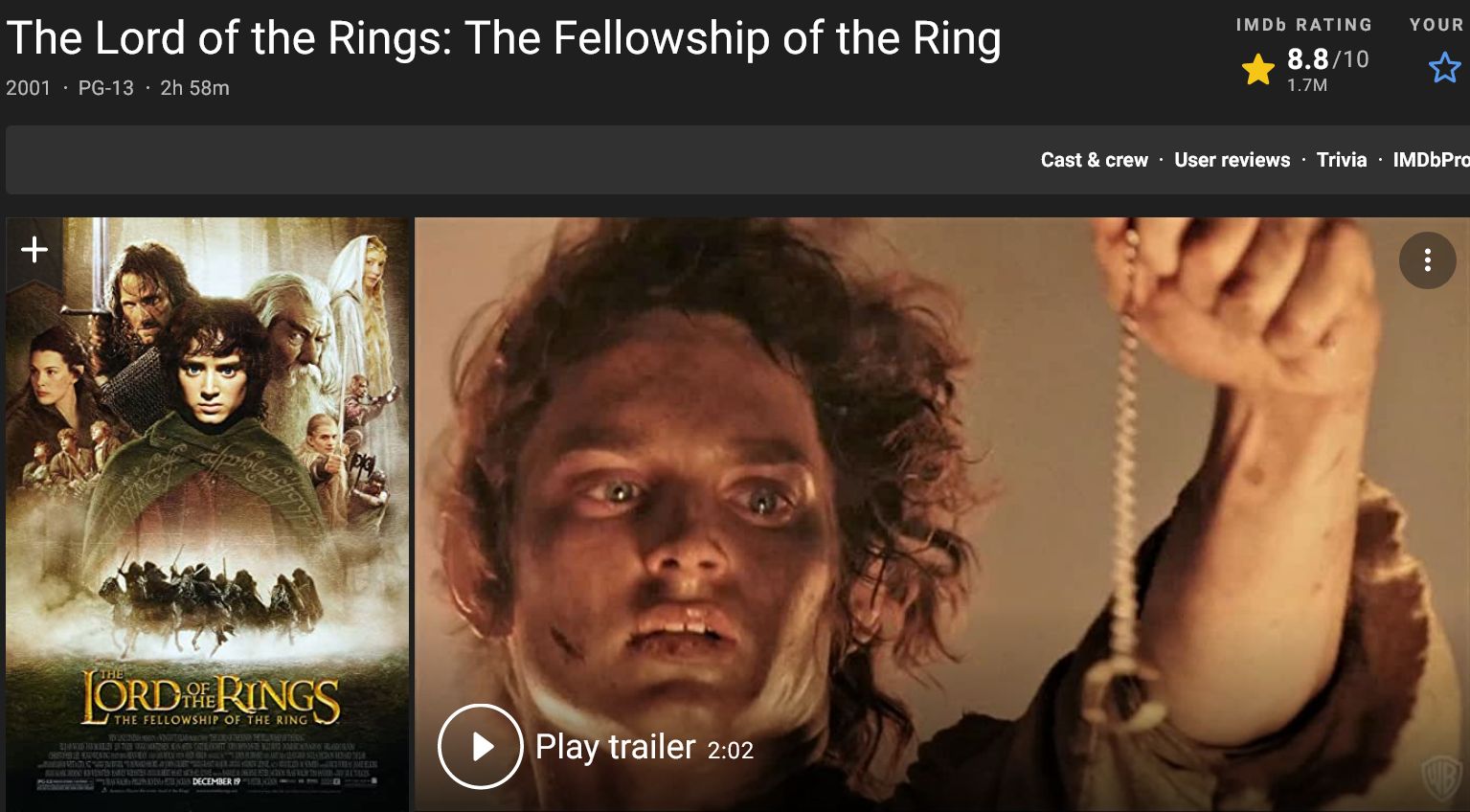
8. LOTR: The Fellowship of the Ring (2001), $870 m
LOTR 1 had more than 500 compositing shots and also won the Oscar for Best Visual Effects. However both the number and quality of shots got better and better as each part of the trilogy was unleashed.

9. Harry Potter and the Chamber of Secrets (2002), $866 m
In the second installment of Harry Potter, two of the key characters were computer generated. One was Dobby the house elf and the other was the basilisk, a fabulous giant snake featured in the climax of the movie. A flying car also added to the fun.

10. Finding Nemo (2003), $865 m
This goldmine of a movie was the tale of two fish, Marlin and his son Nemo, who get separated from each other in the Great Barrier Reef. Pixar admitted during release that this was the toughest movie that they had made till date. Upto 50 animators were used for which fish had to be studied in great detail. The range of expressions that finally went into all the underwater characters was simply amazing.

If you look beyond 10 too, then it’s still animation and effects all the way upto number 19. Forrest Gump (and even that had a few CGI scenes) breaks the tech-trend at a lowly 20th position. So is this the future? Will good acting and Hollywood superstars take totally a backseat and will the man on the computer rule film-making?

(This article appeared in Living Digital magazine in September 2005)

Special effects for Bollywood sir?

LOTRUp close with Hollywood bigwig Barrie Osborne, producer of the Lord of the Rings

In The Matrix, Neo lives in a com puter-generated world, jumps from building to building and indulges in gravity defying fights. In Lord of The Rings (LOTR), a breathtaking Middle Earth is created along with armies and a computer-generated character called Gollum. Both films had ground-breaking special effects and used technology in a spectacular fashion. And they were both produced by Barrie Osborne, who got an Oscar for the final LOTR: Return of the King.

For Osborne it’s been a long journey from China Syndrome in 1979, where trick photography and scale models were mostly used. So, how is Osborne in real life? Totally down-to-earth person and old-fashioned in a way. No flashy gadgets and no overt dependence on technology in the real world. In fact, he’s left the busy life of the US and decided to settle down in quiet and peaceful New Zealand where the LOTR trilogy was shot.

If you’ve seen That Thing You Do then you’ll remember Tom Hanks who always has a pocket notebook and pen in hand to plan everything. Osborne is more in that mould. He prefers to use a pocket notebook for taking notes and writing his schedule. Why not go in for a PDA to manage all that? To that he simply smiles and remarks, “Oh ya, I have an old HP PDA lying somewhere which I have to update”. The same thing is with other gadgets. “I have an IBM laptop and a Sony Ericsson mobile”. He also doesn’t feel the necessity to be with his laptop all the time. His trusted pocket notebook is enough for all his needs. And what about a home theatre? Well that’s when his eyes really light up. He’s got two home theater systems, which he’s passionate about. That’s a Panasonic 60″ plasma screen with a Sony DLP digital projector.

It goes without saying that movies remain his first passion. Face/Off, Dick Tracy and China Moon are some of the other movies he’s been associated with. He has over 30 years of experience, and he was vice president for Feature Production at Walt Disney Pictures and oversaw around 15 motion pictures. He created a record with LOTR, shooting 3 films in a row, in New Zealand.

Osborne was in India recently to promote animation and films here. He’s convinced that there will be a big shift in the Indian entertainment scene and wants to be where the action is. For one, he’s very keen to back Shekhar Kapur’s Pani, a futuristic movie based in India set in a time period where water will be a scarce element. Special effects will play a big role in that movie. Osborne is also keep on producing Paul Cohelo’s The Alchemist, with a fully “Made in India” tag.

What Osborne believes in strongly is that the Indian animation industry can produce movies in the league of LOTR. For that he’s tied up with Indian visual effects expert, Madhusudhan, who also contributed bits for LOTR 3. Together, they’ve set up an outsourcing studio in Chennai that will compete with the best in the world.

So will we soon see a Matrix out of India? Just watch this space.

(This article appeared in Living Digital magazine in July 2005)